Scroll Down
Designing for Disconnected Silos
The Challenge
Spa Space and Arch Amenities Group faced a massive operational hurdle: managing a global network of health professionals and facilities through fragmented, manual processes. The objective was to launch the "Wellness Connect" MVP—a dual-sided marketplace requiring separate, yet deeply integrated, experiences for Facilities and Professionals.
As the Senior Experience Designer for Pod 1 (Pros), my challenge was to define complex requirements from scratch while navigating unstable staging environments and competing stakeholder priorities. We had to deliver a high-fidelity, ADA-compliant product that felt premium and intuitive, while simultaneously building the very Design System that would power it.

Parallel Pod Architecture
The Strategy
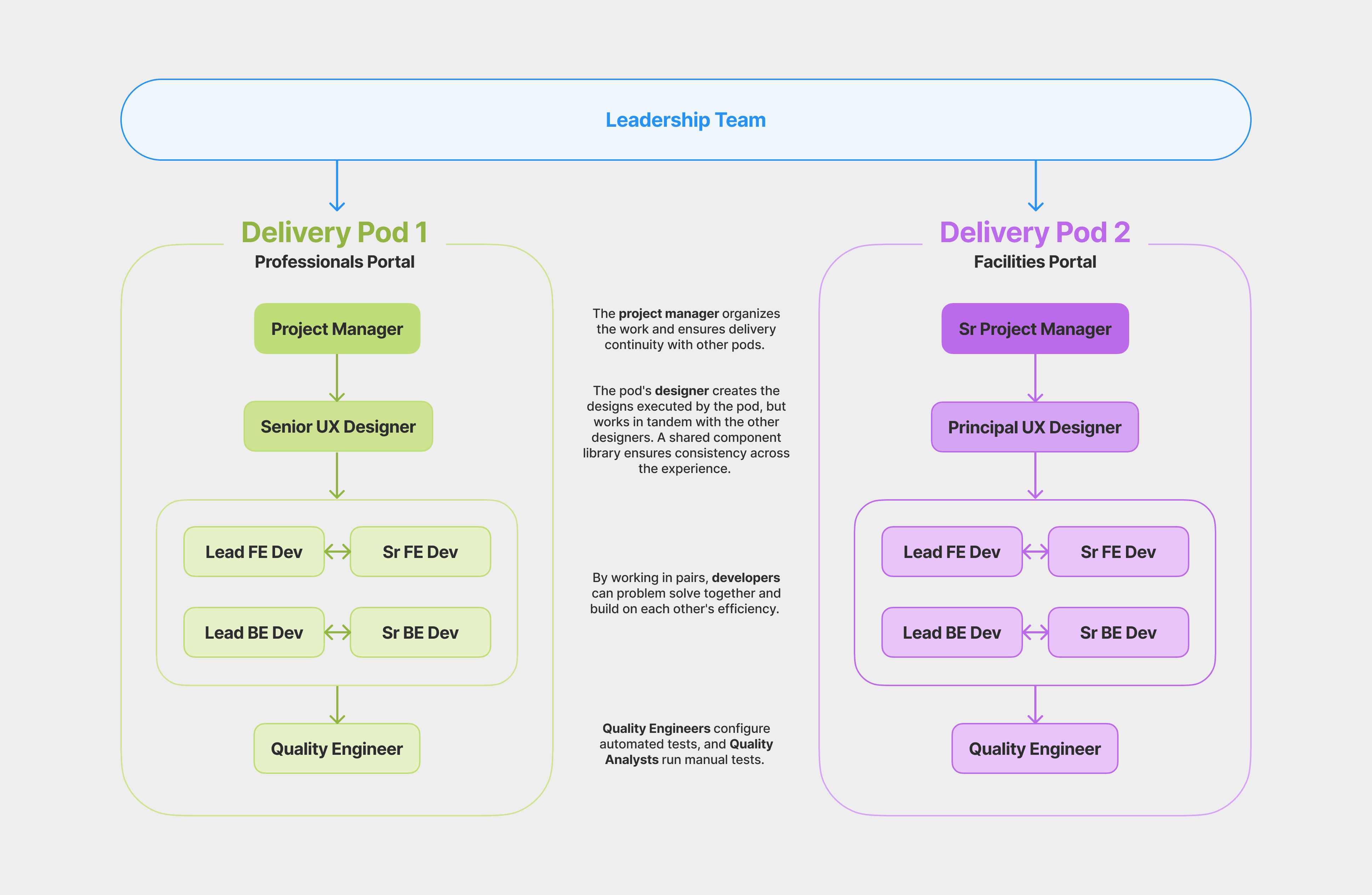
To meet the aggressive 6-month timeline, we utilized a Dual-Pod Structure. While I led the design for the Professional Onboarding & Portal within Pod 1, the design team worked in tandem across both pods to ensure the "shared language" of the product remained unbroken.
My strategy was rooted in Operational Velocity. We conducting Design Sprints and recurring "Leadership Round Tables," we de-risked the roadmap, identifying "MVP Gaps" early to ensure every designed feature aligned with immediate revenue streams like pro-bookings and facility matching.
Engineering a Single Source of Truth
The Build
The heart of the Wellform build was the Design System. I co-created a modular library in Figma consisting of Foundationals, 45+ core components, and 300+ variations. This system supported a fully responsive, 116-screen ecosystem that accommodated both desktop management and mobile-on-the-go professional needs.
Key Architectural Features:
Design-to-Code Storybook Library: Established a "Single Source of Truth" by bridging Figma design tokens directly into 45+ coded Storybook components. This ensures that the .Net/Vue.js implementation maintains 100% fidelity to the original design system while supporting full ADA compliance and responsive behavior.
Self-Guided Modular Onboarding: Engineered a friction-free onboarding system that allows both Facilities and Professionals to register. The flow was architected to be "quick and easy," allowing users to add minimal info to start and complete deep-data sets (like licenses and tax documents) post-onboarding.
Dual-Portal Logic & Dashboard Synergy: Developed parallel portal architectures for Pros and Facilities that synchronize through a centralized data layer. Facility Portal provides a directory-first UI for matched-pro searches and real-time booking tracking, while the Pro Portal focuses on profile visibility and schedule management.
Availability & High-Fidelity Booking Engine: Architected the interaction logic for Pros to set granular availability for on-demand jobs, which is then personalizable by facilities through vessel-type identification and coverage tier filtering.
A Production-Ready Legacy
The Impact
Despite a budget-mandated "hard stop," we delivered a "ready-to-ship" foundation. By the conclusion of the engagement, we had achieved code completion for 10 epics and provided a comprehensive design system that reduced front-end debt by 50%.
The result was a scalable digital ecosystem featuring automated testing, Google Analytics integration, and an ADA-compliant front end. This project proved that systematic design can transform a complex B2B2C business model into a streamlined, high-performance product experience, establishing a tokenized foundation for future growth.